IPM
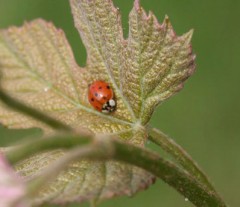
Grape growers benefit from implementing IPM - environmentally and economically sensible ways to protect crops from insects, plant diseases, weeds, and vertebrate pests. We work with grape processors, growers, local extension educators, faculty, crop consultants, and agricultural businesses to find IPM answers, develop new IPM methods, and deliver IPM information.
NYS IPM Program Mission: The New York State Integrated Pest Management Program develops sustainable ways to manage pests and helps people to use methods that minimize environmental, health and economic risks.
Complete IPM Summer Content
Kate Robinson, Administrative Assistant
Edith Byrne, Association Program Educator I

Coming up with the best timing of the various types of insecticides has always been a good topic of discussion. Andy Muza and Tim Weigle have put together a Table: Insecticides for use in New York and Pennsylvania Vineyards (based on one developed by Rufus Isaacs at Michigan State University).
Edith Byrne, Association Program Educator I

Seasonal Primer for Grape Production
Edith Byrne, Association Program Educator I
Images of the Eichhorn-Lorenz Phenological Stages
Adapted from Eichhorn and Lorenz (1977) and Lorenz (1994)
Edith Byrne, Association Program Educator I

Inflorescence elongating: flowers closely pressed together
Edith Byrne, Association Program Educator I

Inflorescence fully developed: flowers separating
Edith Byrne, Association Program Educator I

Early flowering: 25% of caps fallen
Edith Byrne, Association Program Educator I

Full flowering: 50% of caps fallen
Edith Byrne, Association Program Educator I

Late flowering: 80% of caps fallen
Edith Byrne, Association Program Educator I

Fruit set: young fruits begin to swell, remains of flowers lost
Edith Byrne, Association Program Educator I

Berries small: bunches begin to hang
Edith Byrne, Association Program Educator I

Berries pea-sized: bunches hang
Edith Byrne, Association Program Educator I

Beginning of berry touch
Edith Byrne, Association Program Educator I

Beginning of berry ripening: beginning of loss of green colour veraison
Ag Group Herbicide Strategy Comments
Last Modified: October 26, 2023
Letter to EPA regarding:
RE: Draft Herbicide Strategy Framework to Reduce Exposure of Federally Listed Endangered
and Threatened Species and Designated Critical Habitats from the Use of Conventional
Agricultural Herbicides (EPA-HQ-OPP-2023-0365)
Spotted Lantern Fly found in New York State
Kate Robinson, Administrative Assistant
Lake Erie Regional Grape Program
Last Modified: September 14, 2018
The invasive species Spotted Lantern Fly has made its way to New York. Please read the following press release. We need your help to keep an eye out for these problematic pests.
Insecticides for use in New York and Pennsylvania Vineyards (Table)
Edith Byrne, Association Program Educator I
Lake Erie Regional Grape Program
Last Modified: August 7, 2013
Coming up with the best timing of the various types of insecticides has always been a good topic of discussion. Andy Muza and Tim Weigle have put together a Table: Insecticides for use in New York and Pennsylvania Vineyards (based on one developed by Rufus Isaacs at Michigan State University).
Seasonal Primer for Grape Production
Edith Byrne, Association Program Educator I
Lake Erie Regional Grape Program
Last Modified: March 14, 2013
Seasonal Primer for Grape Production
Eichhorn-Lorenz Phenological Stages
Edith Byrne, Association Program Educator I
Lake Erie Regional Grape Program
Last Modified: January 20, 2013
Images of the Eichhorn-Lorenz Phenological Stages
Adapted from Eichhorn and Lorenz (1977) and Lorenz (1994)
PHENOLOGICAL STAGES: Inflorescence elongating: flowers closely pressed together
Edith Byrne, Association Program Educator I
Lake Erie Regional Grape Program
Last Modified: January 12, 2013
Inflorescence elongating: flowers closely pressed together
PHENOLOGICAL STAGES: Inflorescence fully developed: flowers separating
Edith Byrne, Association Program Educator I
Lake Erie Regional Grape Program
Last Modified: January 11, 2013
Inflorescence fully developed: flowers separating
PHENOLOGICAL STAGES: Early flowering: 25% of caps fallen
Edith Byrne, Association Program Educator I
Lake Erie Regional Grape Program
Last Modified: January 9, 2013
Early flowering: 25% of caps fallen
PHENOLOGICAL STAGES: Full flowering: 50% of caps fallen
Edith Byrne, Association Program Educator I
Lake Erie Regional Grape Program
Last Modified: January 8, 2013
Full flowering: 50% of caps fallen
PHENOLOGICAL STAGES: Late flowering: 80% of caps fallen
Edith Byrne, Association Program Educator I
Lake Erie Regional Grape Program
Last Modified: January 7, 2013
Late flowering: 80% of caps fallen
PHENOLOGICAL STAGES: Fruit set: young fruits begin to swell, remains of flowers
Edith Byrne, Association Program Educator I
Lake Erie Regional Grape Program
Last Modified: January 6, 2013
Fruit set: young fruits begin to swell, remains of flowers lost
PHENOLOGICAL STAGES: Berries small: bunches begin to hang
Edith Byrne, Association Program Educator I
Lake Erie Regional Grape Program
Last Modified: January 5, 2013
Berries small: bunches begin to hang
PHENOLOGICAL STAGES: Berries pea-sized: bunches hang
Edith Byrne, Association Program Educator I
Lake Erie Regional Grape Program
Last Modified: January 4, 2013
Berries pea-sized: bunches hang
PHENOLOGICAL STAGES: Beginning of berry touch
Edith Byrne, Association Program Educator I
Lake Erie Regional Grape Program
Last Modified: January 3, 2013
Beginning of berry touch
PHENOLOGICAL STAGES: Beginning of berry ripening
Edith Byrne, Association Program Educator I
Lake Erie Regional Grape Program
Last Modified: January 2, 2013
Beginning of berry ripening: beginning of loss of green colour veraison
Announcements
 Lake Erie Regional Grape Program - Cornell Cooperative Extension
Your Trusted Source for Research-Based Knowledge